Note: Any buttons or tables in this Info Box are disabled, and
are displayed here for referance only.
The primary difference between "Ranked Choice" voting and the standard "One voter/One vote" systems,
is that Ranked Choice allows you to vote for more than one candidate at a time in terms of 1st Choice, 2nd Choice, 3rd Choice, etc.
Ranked Choice Voting is not new; first dating BC, and gained popularity in the 1800's AD.
Here is a short list of the many different versions:
- Plurality (First Past the Post)
- Run-Off
- Instant Run-Off
- Condorcet
- Borda Count
- Single Transferable Voting (STV)
- Single Transferable Voting (STV) w/ Borda elimination
- Meek Style STV
- Meek Style STV w/ Borda elimination
- Pair Wise
- Approval Voting
- and many more
And all of these have different methods as how to count the votes & select a winner.
Many of these were built on top of a previous one, so they are similar.
And a few add different features, such as, electing the top two
candidates, and more.
"Looks too Confusing & Complicated!" ~ is the most common argument against RCV.
We agree: trying to learn each one of these systems
and then selecting the best one to use is a daunting task...
So we set out to identify the most accurate & simplest one.
In the process of learning the different versions we realized that the majority
and simplest of the methods were based on first finding the weakest candidates, and
then eliminating them from the election one by one until only the winner was left standing.
As the testing of the versions became more complicated, we decided to build a tool
to test the different versions for accuracy and speed. Ultimately the tool became
its own process using techniques from most of the existing RCV versions.
Our tool is quite simple. it's based on eliminating the weakest candidate
and then adjusting the remaining choices, one candidate at a time.
So if we have 6 candidates running, we'll have 5 elimination rounds.
We demonstrate this step by step by clicking on Step 1 & Step 2 buttons,
This might appear slow, but is intentional, pausing between steps so as to see
what takes place, In a real election the process can count a 100k plus ballots
in seconds.
Again, the 1st Step; finds the weakest candidate & removes all their votes from
the "Active Vote" display. The 2nd Step; shifts any remaining choices up into a
higher preferance level, which increases the value of that vote, giving it higher ranking.
For example, if my 1st choice loses, then my 2nd choice becomes
my 1st choice, & my 3rd choice becomes my 2nd, etc.
There is no calculating percentages or threasholds reaching
50%'s, or 35%'s etc, or adding "weighting" of the counts based on choice, etc.. .
Its very simple. it uses only addition, subtraction and the shifting of a pointer to the
data in an array. and is lightning fast !!!
This might be hard to grasp, but we have built the RCV Visual Demo,
that makes it super easy to see it in action and understand
how it works...
This process is introduced on The Visual Tabulation page here,
Rcv Tools ~ Visual Tabulation Demo
RCV ~ also eliminates the "Spoiler Effect" associated with Two Party Elections and
makes efforts to Gerrymander very weak.
RCV ~ introduces new faces & new candidates w/o Party Alignment & Allegiance.
RCV ~ Gives us more Options & Choices, more information on issues & referance
for future support.
Some describe RCV as a Consensus-Based voting system rather than a majoritarian one.
 RCV Election Tools ~v1.1
 which toggles the App View,
as well as the individual &
buttons positioned above the Tables.
which toggles the App View,
as well as the individual &
buttons positioned above the Tables.


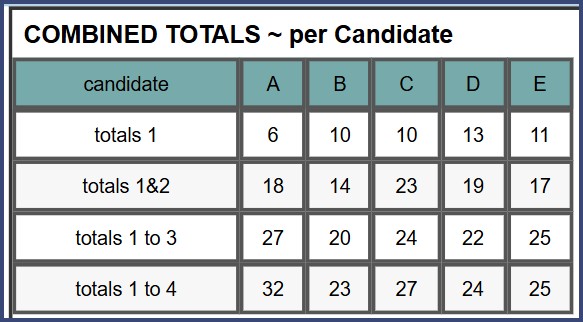 as you can see ... the the first row labeled "totals 1" shows the total 1st Choice votes for each candidate,
... The 2nd row labeled "totals 1&2" shows the combined totals of 1st Choice & 2nd Choice votes for each candidate, etc.
as you can see ... the the first row labeled "totals 1" shows the total 1st Choice votes for each candidate,
... The 2nd row labeled "totals 1&2" shows the combined totals of 1st Choice & 2nd Choice votes for each candidate, etc.